
Design guide · 11 min read
Wardrobe Design in Pune: Sliding vs Hinged, Materials, Finishes and Cost
Wardrobes are a quarter of a typical home interior budget, and most people spend about ten minutes deciding on them. Here is what to think about instead.
Most homeowners spend weeks on the kitchen and about ten minutes on the wardrobes. That is backwards. On a typical full home, wardrobes and storage take roughly a quarter of the budget — almost as much as the kitchen — and you will open them more often than any kitchen drawer. Good wardrobe design in Pune flats is mostly about solving small rooms, awkward walls and a long humid monsoon, and very little about picking a shutter colour.
This guide walks through the decisions in the order we would make them: door type, height, interior layout, board, shutter finish, mirrors and lighting. Then it covers small bedrooms specifically, and what wardrobes should cost as a share of your budget. Some of the advice will steer you towards the cheaper option. That is fine.
Sliding vs hinged: the first real decision
This choice is usually made on looks. It should be made on the room.
| Hinged (openable) | Sliding | |
|---|---|---|
| Floor space needed in front | Needs clearance for the door swing | No swing; works where the bed is close |
| Access | Open the whole wardrobe at once | See only part of the wardrobe at a time |
| Interior planning | Very flexible | Must plan around where shutters overlap |
| Hardware sensitivity | Hinges are simple and easy to adjust | Depends heavily on track and roller quality |
| Look | Classic; works with any finish | Clean, wide panels; suits mirrors and large finishes |
| Cost | Usually lower | Usually higher, because of the track system |
Choose hinged when
- There is enough clear floor between the wardrobe and the bed for a door to swing open fully — and for you to stand in front of it.
- You want to see the whole wardrobe at once, for example in a shared master wardrobe.
- You want the most flexible interior layout and the lowest cost.
Choose sliding when
- The bed or a study table sits close to the wardrobe and a swinging door would hit it.
- The wardrobe is wide and you want a few large, uninterrupted panels — often with mirrors.
- You accept that you will only see part of the interior at once, and you are willing to pay for a good track system.
A sliding wardrobe is only as good as its track. Cheap tracks wobble, jump and collect dust, and Pune’s dusty summers do not help. If you choose sliding, ask for the track and roller system by brand, and make sure the quote states it.
Height: loft, full height, or neither
Most Pune flats have enough ceiling height for a wardrobe plus a loft above. You have three options.
- Standard height with a separate loft. The main wardrobe stops at about 7 feet, with a loft unit above to the ceiling. Cheaper, and the loft is good for suitcases and seasonal bedding.
- Full height, single shutter. Tall shutters run floor to ceiling. It looks cleaner and makes the room feel taller, but very tall shutters need good board and hinges to stay straight.
- No loft. Leaves a gap above the wardrobe. Rarely worth it unless there is a beam, an AC unit or a window in the way — the gap collects dust and you lose storage.
Our usual advice: go to the ceiling, one way or another. The top section is the cheapest storage you will ever buy per cubic foot. Whether it is a separate loft or a continuous full-height shutter is mostly a matter of look and budget. Coordinate it with your ceiling plan if you are doing a false ceiling — our page on false ceiling and lighting explains why.
Inside the wardrobe: plan for what you own
The interior layout is where a wardrobe becomes useful or annoying. Before the design meeting, spend ten minutes counting what you actually store: how many shirts and trousers you hang, how many sarees, how much folded clothing, how many pairs of shoes, how much luggage.
Useful internal accessories
- Two hanging heights. A double rail for shirts and folded trousers holds roughly twice as much as one long-hang section. Keep one long-hang section for dresses, kurtas and coats.
- Drawers at waist height for innerwear, accessories and documents. Put a lockable drawer in at least one wardrobe.
- Saree or trouser pull-outs keep folds neat and visible.
- Tie, belt and jewellery trays in a shallow drawer.
- A pull-down hanger rail in a full-height wardrobe makes the top section usable without a stool.
- Shoe racks — either in the wardrobe or in a separate shoe cabinet near the entrance, which is usually better for Indian homes.
- A dedicated slot for the vacuum, ironing board or luggage if you have no utility storage elsewhere.
Do not overspend on accessories you will not use. A wardrobe full of clever pull-outs costs more and holds less than a simple layout of shelves, rails and two drawers. Good runners and hinges matter more than the number of gadgets — we use Hettich hardware for both.
HDHMR vs plywood: what should the carcass be made of?
This is the most important decision you will not be able to see once the wardrobe is built.
HDHMR (high-density, high-moisture-resistant) board is an engineered board made of compressed wood fibre. It is dense, flat, stable and takes a clean edge, which makes it very good for wardrobe carcasses and tall shutters that need to stay straight. It also resists moisture well, which matters through a Pune monsoon. We use Greenply HDHMR boards for wardrobes.
Plywood is made of glued wood veneers. Good plywood is strong, holds screws well and is the right choice where there is serious water exposure. BWP (boiling water proof) plywood is what we use in kitchens, particularly around the sink.
In a bedroom wardrobe, which is not exposed to running water, good-quality HDHMR performs very well and gives you a flatter, more stable panel. Plywood is not wrong, but the extra cost of premium plywood in a bedroom is often better spent on the shutters or the hardware. What you should avoid, in either case, is unbranded board described only as ‘waterproof’ or ‘marine’. Ask for the brand and grade in writing.
A note on bathroom-adjacent walls
In many Pune flats, a bedroom wardrobe sits against a bathroom wall. If that wall has any dampness — check for paint bubbles or patches, especially after the monsoon — fix it before installation, and ask your designer to leave a small gap or use a moisture barrier behind the wardrobe. No board will survive a wet wall forever.
Shutter finishes: laminate, acrylic, PU and mirror
The shutter is what you see every day, and the finish decides both the look and how much maintenance you sign up for.
| Finish | Look | Durability | Maintenance | Relative cost |
|---|---|---|---|---|
| Laminate | Huge range — matte, textured, woodgrain, solid colours | Very good; resists scratches | Easy; wipe clean | Lowest |
| Acrylic | High gloss, deep colour | Good, but scratches show | Shows fingerprints and smudges | Medium |
| PU paint | Seamless painted look, matte or gloss | Good with care; chips can be touched up | Moderate | Highest |
| Mirror / glass | Reflective; makes rooms feel bigger | Good with safety backing | Needs regular cleaning | Medium to high |
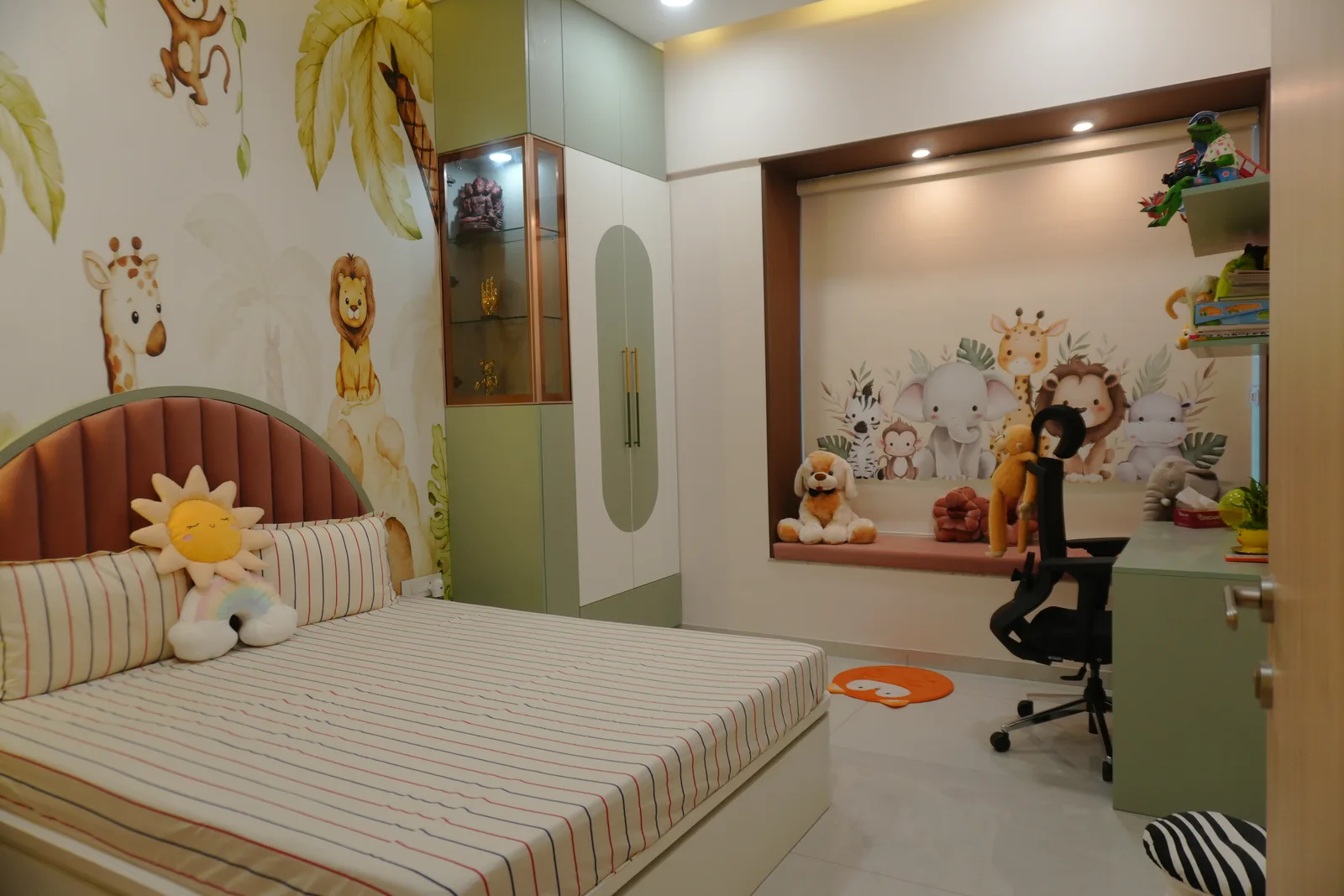
Laminate is the honest workhorse. For most bedrooms, especially children’s rooms and guest rooms, a good laminate is the right answer. Modern laminates — we use Merino — include convincing woodgrains and soft-touch matte finishes that look far more expensive than they are.
Acrylic gives a glossy, glass-like finish that looks spectacular in photos and in a master bedroom. It also shows every fingerprint. If you choose it, consider gola or profile handles so you are not touching the face of the shutter.
PU paint gives a seamless, colour-matched finish with no visible edge lines. It is the premium option, and suits Lux-style bedrooms where the wardrobe is part of the architecture. It costs more and needs a little more care.
Mirror shutters
A mirror shutter on a sliding wardrobe can make a small bedroom feel considerably bigger and saves you buying a separate dressing mirror. Two rules: use mirror with a safety backing film so it does not shatter dangerously if broken, and do not put a mirror directly facing the bed if that bothers you — many people find it does. Tinted or bronze mirrors are a softer alternative to clear glass.
Lighting inside and around the wardrobe
Wardrobe lighting is cheap to add during manufacture and annoying to add later. Worth considering:
- Sensor-activated LED strips inside each section that switch on when the door opens.
- Profile lighting on the hanging rail so you can tell navy from black at 7 a.m.
- Lighting inside a glass-fronted section if you have one for bags or accessories.
- A switched light above a loft, if the loft is deep.
- Planned electrical points — the wiring for wardrobe lights needs a supply point, which has to be planned with your electrical layout, not improvised after the wardrobe arrives.
Small-bedroom wardrobe tips for Pune flats
Second and third bedrooms in many Pune 2 BHK and 3 BHK flats are compact, and the wardrobe often has to share a wall with the door, a window or the AC. Some tactics that work:
- Go sliding if the bed is close. Even a narrow swing becomes a daily irritation in a tight room.
- Go to the ceiling. Vertical storage is what small rooms have; floor space is what they lack.
- Use light, matte finishes or a mirror panel to stop a full wall of wardrobe from feeling heavy.
- Use handle-less or profile-handle shutters so nothing protrudes into a narrow passage.
- Consider a corner wardrobe if one wall is broken by a window — an L-shaped wardrobe can recover space a straight run cannot.
- Combine functions. A wardrobe with a built-in study desk or dresser can replace two separate pieces of furniture.
- Check the door swing of the room itself. Many wardrobes are designed in plan and then found to clash with the bedroom door.
A 3D view is particularly useful here. With our 3D design and VR walkthrough you can stand in the virtual room, open the virtual wardrobe and see whether it clears the bed before anything is cut.
Common wardrobe mistakes we see in Pune flats
- Designing the wardrobe before the bed. Fix the bed position and size first; the wardrobe door type follows from it.
- Forgetting the AC. Split AC indoor units are often mounted above the wardrobe wall. Leave the clearance the AC installer needs, or the loft shutter will not open.
- One long-hang section for everything. Most people hang far more shirts and trousers than long garments. Double rails hold more in the same width.
- Skipping edge banding on hidden edges. The back and top edges are where monsoon moisture gets in. Every edge should be sealed.
- Choosing gloss for a child’s room. Fingerprints and scratches arrive within a week. Matte laminate is the kinder choice.
- Leaving lighting to the end. Without a supply point planned in the electrical layout, wardrobe lights end up battery-powered or not fitted at all.
What wardrobes cost as a share of your budget
On our typical full-home budget split, wardrobes and storage account for about 24% of the total — second only to the modular kitchen at about 26%. Using our Premium collection’s indicative ranges, that works out roughly as follows:
- 2 BHK Premium (₹9–11 L): 24% of ₹9 L is about ₹2.16 L; 24% of ₹11 L is about ₹2.64 L. So roughly ₹2.2–2.6 lakh on wardrobes and storage.
- 3 BHK Premium (₹12–14 L): 24% of ₹12 L is about ₹2.88 L; 24% of ₹14 L is about ₹3.36 L. So roughly ₹2.9–3.4 lakh.
These are illustrations from a typical split, not quotes. Your share will move with the number of bedrooms, wardrobe heights, shutter finishes and how much other storage (shoe cabinet, TV unit, study) you add. If you only need a kitchen and wardrobes, that combined scope is roughly 60% of a full-home price. For full figures by flat size, see our 3 BHK cost guide, or run your own numbers on the cost calculator.
Every wardrobe we build is manufactured in our own factory in Balewadi, fitted by our own team and covered by our 10-year written warranty on the carcass, joinery, finish and installation, with hardware carrying the brand’s own warranty. *Terms & conditions apply. You can see our wardrobe work and approach on the wardrobe design in Pune page.
Frequently asked questions
Which is better for a Pune bedroom, sliding or hinged wardrobes?
It depends on the room, not the trend. If there is enough space in front for a door to swing and for you to stand, hinged is cheaper and gives full access. If the bed is close or the wardrobe is very wide, sliding works better — but only with a good-quality track.
Is HDHMR good enough for wardrobes?
Yes. Good HDHMR is dense, flat, stable and moisture resistant, which makes it very well suited to bedroom wardrobes and tall shutters. We use Greenply HDHMR for wardrobes and keep BWP plywood for kitchens, where water exposure is higher.
Laminate or acrylic for wardrobe shutters?
Laminate is more durable, easier to maintain and cheaper; acrylic gives a high-gloss look but shows fingerprints and scratches. Many people choose acrylic or PU for the master bedroom and laminate for the other rooms.
Should my wardrobe go up to the ceiling?
Almost always, yes — either as a full-height wardrobe or with a separate loft. The top section is inexpensive storage for luggage and seasonal items, and leaving a gap just collects dust.
How long does it take to make and install wardrobes?
For a modular-only scope such as our Essential collection, design takes about 10–15 days and delivery is 45–60 days after design approval and site readiness. Installation on site is quick because the units are made and pre-drilled in the factory.
The difference between a good wardrobe and a cheap one is mostly invisible in a showroom: board, edge banding and hardware. Come and see them being made at our studio and factory in Balewadi, open Tuesday to Sunday — or start with a quick estimate on the cost calculator.
While you're here
Want the number for your flat?
Ten seconds, no email gate, no “an advisor will call you with a price.”
Price your home